

On 25 October people will gather in Robert Owen’s old School for Children at New Lanark to tell stories.
Telling New Lanark’s Stories is collecting memories from people who lived, worked, studied, or had family in the village, adding them to an oral history archive that already preserves the voices of generations who called this extraordinary Mill town by the Clyde Falls home.
Few places are better suited to thinking about which stories we preserve.
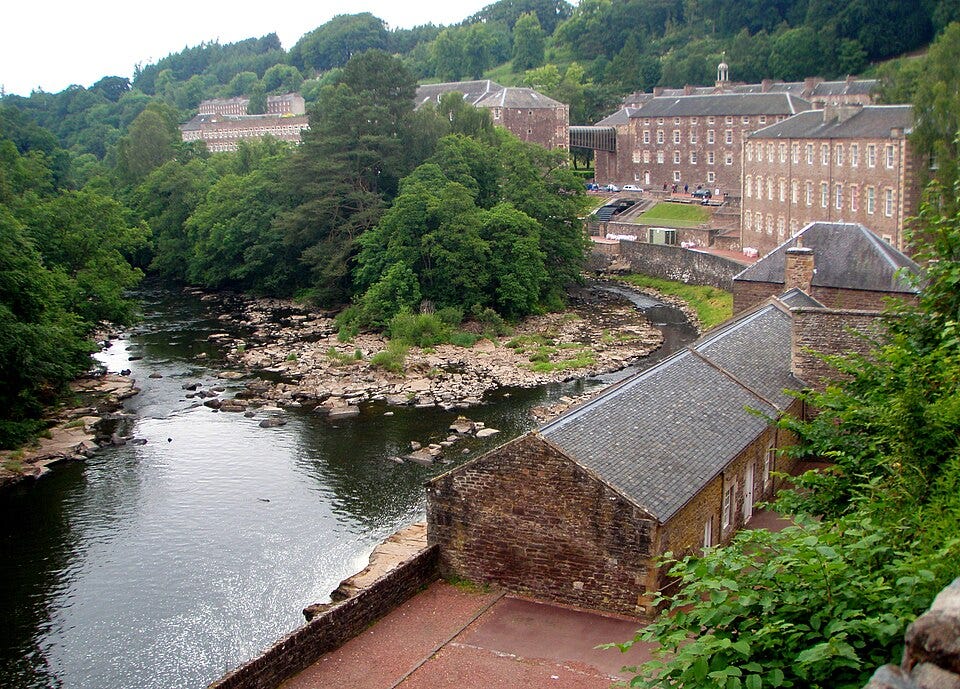
New Lanark is a landmark in the history of education, factory reform and the co-operative movement. It is a UNESCO World Heritage Site, and Robert Owen, who managed its mills from the turn of the nineteenth century, occupies an established place in the history of British socialism.
Another branch of that story is less often told: The radical ideas Owen experimented with at New Lanark at the start of the nineteenth century influenced Proudhon, Kropotkin, the First International, and early American anarchists.
A factory owner tries to change the world
An obvious problem with recruiting Owen into an anarchist pantheon: he was very much the boss.
When Owen took over the management of New Lanark in 1800, it was already one of Britain’s great industrial settlements. Cotton mills powered by the Clyde employed around 2,000 people. Owen did not abolish the factory system. He ran one of its most successful, and radical, examples.
New Lanark was not a self-governing commune; it had a hierarchy: Owen believed profoundly that circumstances shaped human character, but the corollary was that enlightened people such as Robert Owen ought to create the right circumstances for everyone else.
So his reforms could therefore be startlingly progressive and deeply paternalistic at the same time.
Working hours were reduced. Young children were taken out of the mills. Education became central to village life. The Institute for the Formation of Character opened in 1816, followed by the School for Children. Corporal punishment was rejected, and education included music, dancing, nature, art, history and geography rather than simply drilling children in obedience and scripture. New Lanark also developed what is described today as the world’s first workplace nursery.
Yet Owen also introduced the wonderfully Orwellian-sounding “Silent Monitor”, a coloured block displayed beside workers showing his judgement of their behaviour and performance.
This was emancipation administered from the manager’s office.
An anarchist can reasonably look at New Lanark and ask a fairly fundamental question: what happens when the benevolent master stops being benevolent?
The answer cannot simply be to hope for better masters.
But that is also where Owen becomes interesting. His argument did not stop at the idea that capitalism merely needed kinder capitalists. By 1820, in his Report to the County of Lanark, Owen concluded that reforming individual factories was insufficient. New Lanark’s own historical account summarises the turning point neatly: “reform alone is not enough”; the social order needed to change.
Crucially, the successful mill owner had begun criticising the very system which had made him successful.
Change the conditions, and the people will change themselves
The big lie at the heart of capitalist morality is that of the undeserving poor: that the rich are rich because of virtue. That oligarchs like Elon Musk and Donald Trump deserve their wealth for being ‘smart’ and ‘working hard’ while people with low incomes are poor because of personal failures. Billionaires deserve their tax cuts; welfare recipients deserve their suffering.
One of Owen’s most radical ideas sounds almost mundane today: people are largely shaped by the conditions in which they live. Poverty was therefore not evidence that people experiencing poverty were morally defective. Crime could not be explained by wicked individuals alone. Ignorance was not an inherent characteristic of the working class.
Change the conditions and people themselves will change.
In A New View of Society, Owen described how changing the environment of New Lanark transformed the community without relying on punishment.
There’s something recognisably libertarian in that shift away from sin, blame, and punishment towards social conditions, even if Owen’s proposed solution often retained an uncomfortable degree of social engineering.
Recent scholarship has consequently traced Owenite thought not only into socialism and co-operation but into the pre-history of penal abolitionism: if social conditions produce harmful behaviour, changing those conditions may make punishment unnecessary.
Owen’s direct experience showed something else.
People flourish when they have decent housing, education, security, leisure and access to meaningful community life.
It is deceptively simple, and we’ve known this for centuries. The fact that it is not reflected in how our society is structured is a deliberate choice by those in power.
Co-operation instead of competition
New Lanark showed that industrialised economic relationships did not have to be organised entirely around extracting the maximum possible return from workers and consumers.
Owen’s village store sold good-quality goods at affordable prices and used its surplus to support his educational reforms. New Lanark itself describes the store as an inspiration for the later co-operative movement.
In a similarly reductionist oversimplification, Proudhon is called ‘The Father of Anarchy ‘; Owen is sometimes cast as ‘the father of the co-operative movement’, but Owen didn’t invent co-operation. Scottish weavers at Fenwick had organised a co-operative society decades earlier.
But the Rochdale Pioneers of 1844 developed the model that became the foundation of the modern movement, and Owenism was part of the soil from which Rochdale grew. The International Co-operative Alliance links principles discussed at the Co-operative Congress Owen chaired in 1832 with those developed by the Rochdale Pioneers.
For anarchists, Owen’s followers increasingly moved the idea beyond benevolent provision for workers towards economic organisation by workers.
During the labour upsurge of the early 1830s, Owen became involved with attempts to form a general union embracing workers across trades. At the 1833 Builders’ Parliament, delegates discussed a national guild that could effectively take the building industry out of contractors’ hands. Owen later became closely involved with the Grand National Consolidated Trades Union and promoted labour exchanges intended to let producers trade goods without conventional capitalist intermediaries.
Owen himself remained suspicious of class conflict: Some ‘Owenites’ did not.
Owenism, mutualism and anarchism
Peter Kropotkin read Owen as belonging to the intellectual primordial soup from which anarchism emerged.
In Modern Science and Anarchism, published by Freedom Press in English in 1912, Kropotkin placed Robert Owen alongside Fourier and Saint-Simon as one of the founders of modern socialism before distinguishing the anti-authoritarian current which developed through Proudhon and the revolutionary socialist movement.
When Kropotkin described the forces that came together in the International Working Men’s Association, he presented one stream as French workers influenced by Proudhonian mutualism and another as British trade unionists shaped by Owenism.
He described it concisely:
“English Owenism thus joined hands with French ‘Mutualism’.”
While Kropotkin thought Proudhon’s economics adopted Owen’s system of labour notes, modern anarchist scholarship has focused more on differences than similarities.
Owen’s unfinished experiment
Two hundred years later, New Lanark remains physically astonishing because so much of Owen’s experiment is still there. The school stands. The Institute stands. The workers’ housing and mills survive around them. UNESCO describes the village as a model for industrial communities whose influence continued internationally into the nineteenth and twentieth centuries.
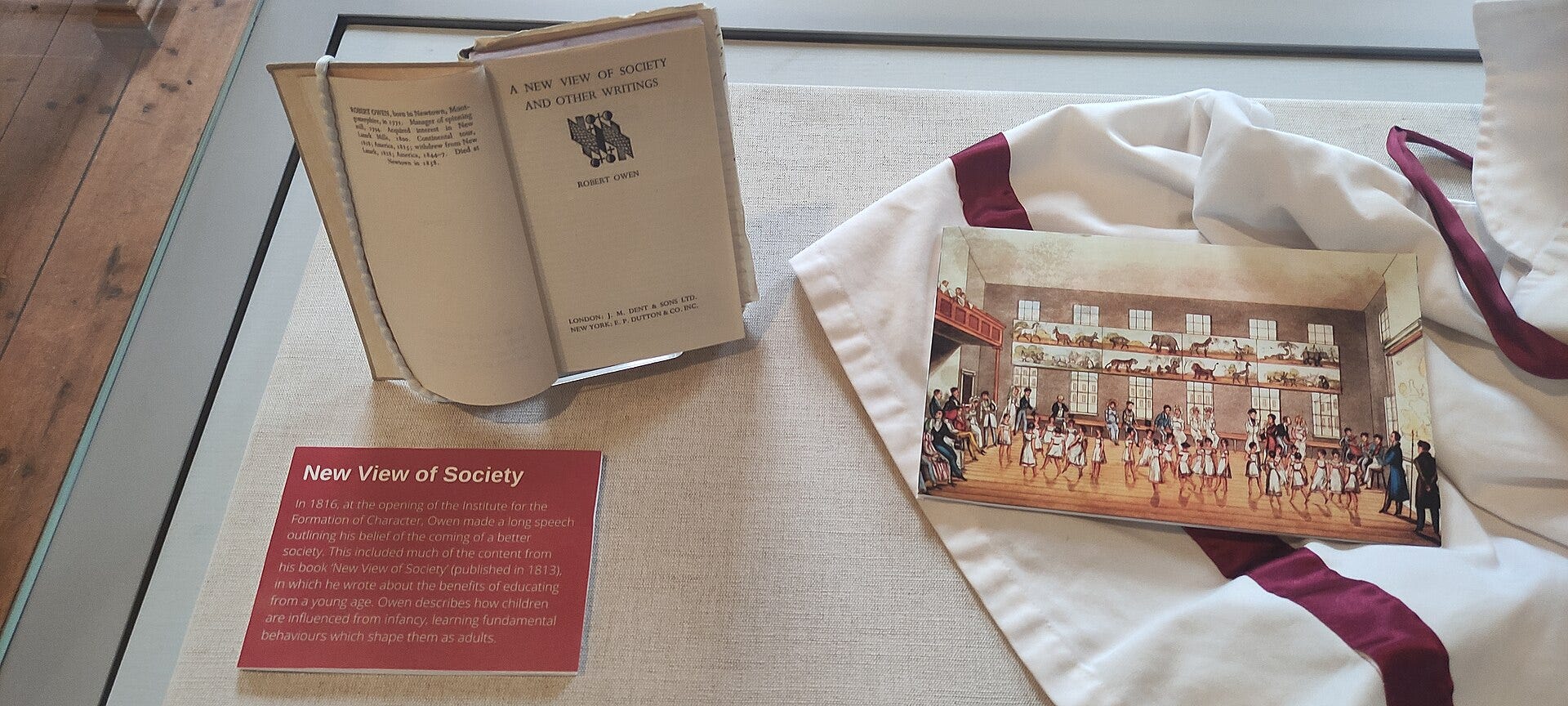
The buildings, impressive as they are, are not Owen’s legacy -That is rather in the co-operative movement, whose organisations demonstrated that businesses could be collectively owned rather than only to extract maximum value for external property owners. His legacy is in his influence on trade unionism and experiments in workers taking control of production.
His insistence that poverty and crime have social causes beyond sinful individuals.
And, less directly but still traceably, it appears within anarchism.
Owen never overcame the paternalism at the heart of his vision, but the humane industrialism of New Lanark planted seeds that Anarchism took further.
If education can develop free human beings, those human beings can organise themselves.
If ordinary people can co-operate, they don’t need a factory owner above them dictating terms.
If economic life can be constructed around co-operation instead of competition, ownership by a capitalist — however enlightened or benevolent ceases to be necessary; indeed, it maintains a systemic flaw that oppresses when a less benevolent owner takes control.
Circumstances create misery, and we can change the circumstances rather than punish those trapped within them.
And if small experiments can demonstrate that another form of social organisation is possible, then we do not need to wait for permission from parliament, capital or some future revolutionary government before beginning to construct it.
That is perhaps the most anarchistic thing about New Lanark; It was an experiment in alternative organisation. A winding path runs from this mill beside the Clyde to co-operatives, labour exchanges, trade unionism, mutualism and anarchism.
Owen didn’t write some Utopia or Republic about a vision of a perfect society. He tried to build one. Praxis. Some ideas worked. Some attempts failed. Some spread ideas considerably further than he was willing to go.
Importantly, the stories of the New Lanark workers and community are still being told and remembered. Telling New Lanark’s Stories takes place on Sunday 25 October 2026 from 10 am to 4 pm at Robert Owen’s School for Children, New Lanark. Organised by Lanark Community Development Trust, a charitable, non-profit volunteer body that carries out projects for the common good, this event will celebrate the New Lanark Oral History Archive through a day of storytelling, conversation, and community participation.
Admission is free.