

Officers seized 561 e-bikes and 441 e-scooters between 1 January and 16 October 2026, a total of 1,002 vehicles. That compares with 569 seized throughout 2025, when seizures had already risen by more than 60% on the previous year.
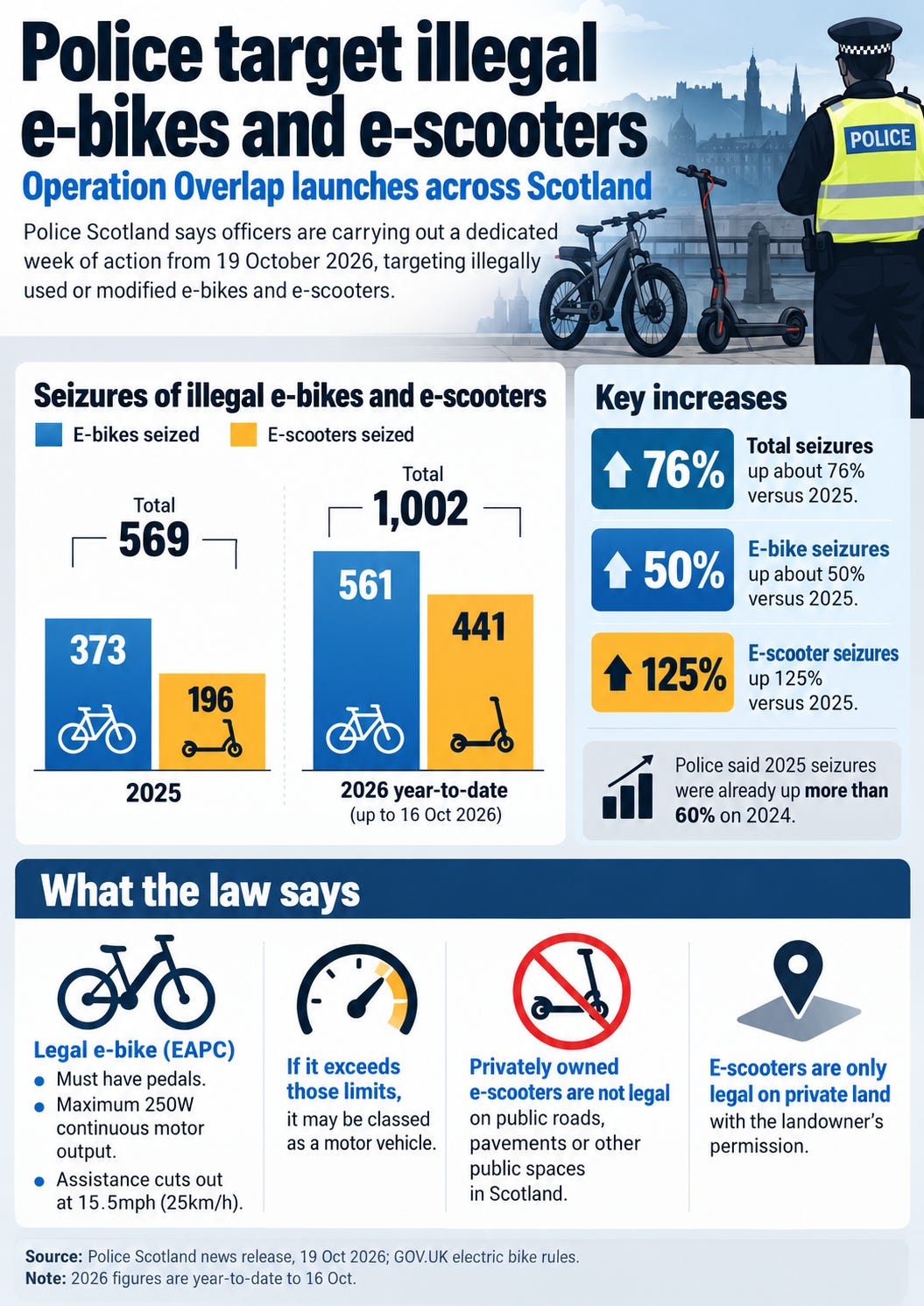
The sharpest increase has been in e-scooters, with 441 seized this year compared with 196 throughout 2025 — a rise of 125%.
Police Scotland launched Operation Overlap on Monday, 19 October, with road policing officers and local divisions carrying out targeted enforcement across Scotland.
The operation aims to tackle illegally modified electric bikes, unlawful e-scooter use and anti-social behaviour involving the vehicles.
Superintendent Andy Barclay, Police Scotland’s Deputy Head of Road Policing, warned that illegally modified e-bikes are dangerous and put riders, pedestrians and other road users at risk.
“We know from reports made to us that concern about the misuse of e-bikes and e-scooters is a growing issue across Scotland. We want to be clear that illegally modified e-bikes are dangerous and not suitable for the public road. They pose a risk to their own riders and other road users, particularly pedestrians.
This week of activity will focus on removing these vehicles from the roads and I want to be clear that anyone found riding a non-compliant e-bike or e-scooter on a public road will faces the risk of having it seized by officers and destroyed.”
Superintendent Andy Barclay
Police Scotland could seize and destroy vehicles that fail to meet legal requirements. Police say that although most e-bike users follow the rules, some machines have been modified to travel faster or deliver greater motor power than the law permits.
Such modifications can turn what would otherwise be a legally recognised bicycle into a motor vehicle, bringing additional requirements for licensing, insurance and registration.
The crackdown follows calls for stricter legislation. Writing in Scottish legal news in August this year Thomas Mitchell, a partner at RTA LAW LLP highlighted the risks.
“Over the past 12 months, the number of children attending accident & emergency in NHS Greater Glasgow and Clyde due to e-scooter or e-bike incidents has increased by more than 600 per cent. E-scooter use needs to be legislated for and it needs to be done now.”
Thomas Mitchell - Scottish Legal News
How do you know if an e-bike is legal?
Under UK law, an electrically assisted pedal cycle (EAPC) can be ridden on public roads and cycle paths without a driving licence, tax or insurance, provided it meets several requirements.
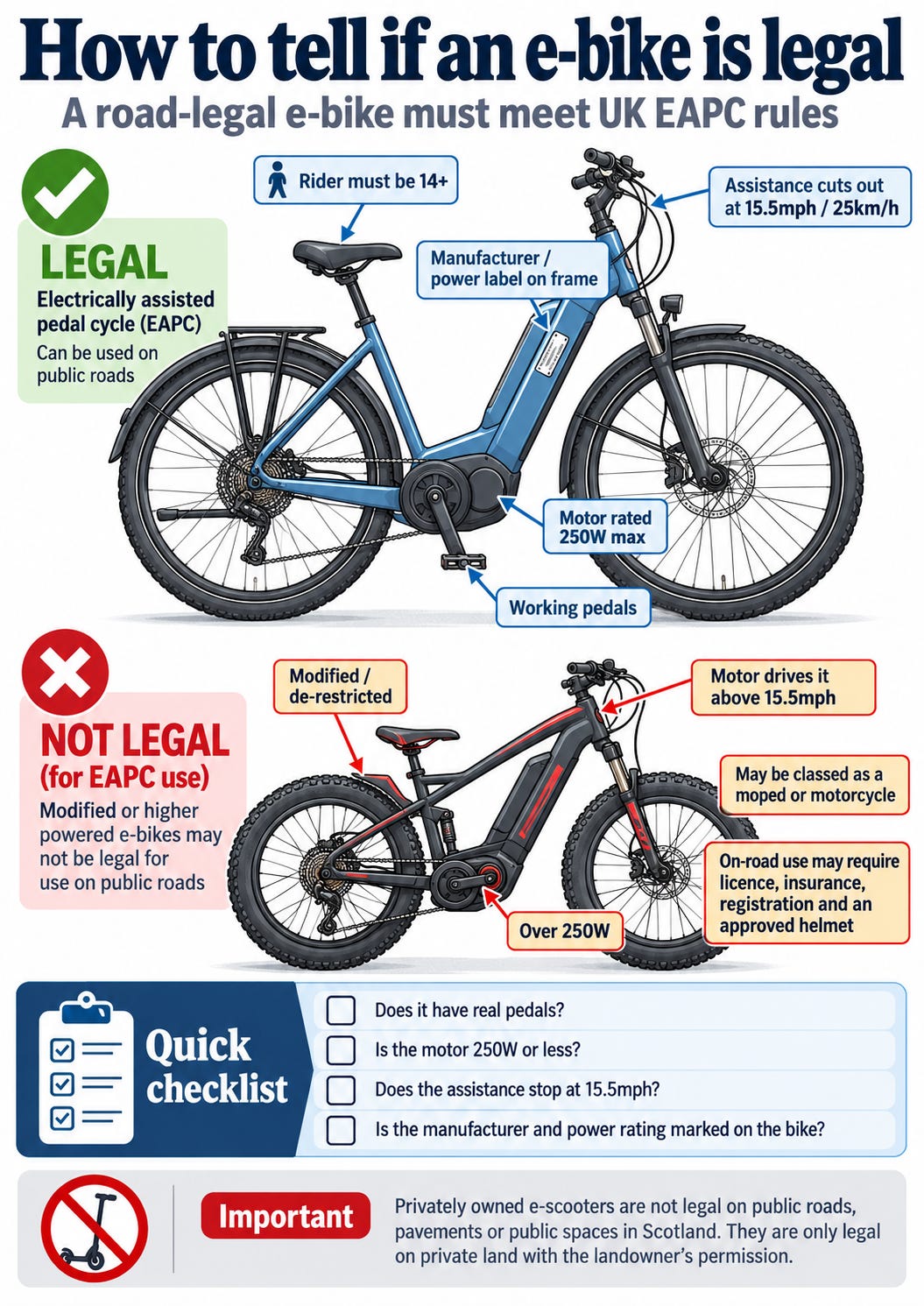
The bike must have functioning pedals, its motor must have a maximum continuous rated output of 250 watts, and electrical assistance must stop once it reaches 15.5mph (25km/h).
Riders must be at least 14 years old. A bicycle can still travel faster than 15.5mph through pedalling or downhill momentum, provided the motor is no longer providing assistance.
The manufacturer and motor power rating must also be marked on the bicycle.
Bikes that do not meet these requirements are generally treated as motorcycles or mopeds. To be used legally on public roads, they must satisfy the relevant vehicle approval, registration, tax and insurance requirements, while riders need an appropriate driving licence and approved motorcycle helmet.
Some throttle-operated e-bikes can also qualify as EAPCs, but they may require specific vehicle approval.
In January 2025, the UK Government abandoned proposals to increase the permitted motor power for ordinary e-bikes from 250 to 500 watts, following opposition from stakeholders and concerns about insufficient supporting evidence.
The government has also warned that modifying e-bikes to remove speed restrictions can increase electrical loads, causing batteries and drive systems to overheat and may increase the risk of fire.
What about e-scooters?
Unlike compliant e-bikes, privately owned electric scooters cannot legally be ridden on public roads, pavements or other public spaces in Scotland. They may only be used on private land with the landowner’s permission.Although government-authorised rental e-scooter trials operate in parts of England, Scotland has no equivalent authorised public-road schemes. The English trials have been extended until May 2028.
Further information is available from the UK Government’s electric bike guidance.
There is an active UK Parliament petition calling for legalisation and regulation of privately owned e-scooters and higher-speed e-bikes. It closes on 27 October 2026