

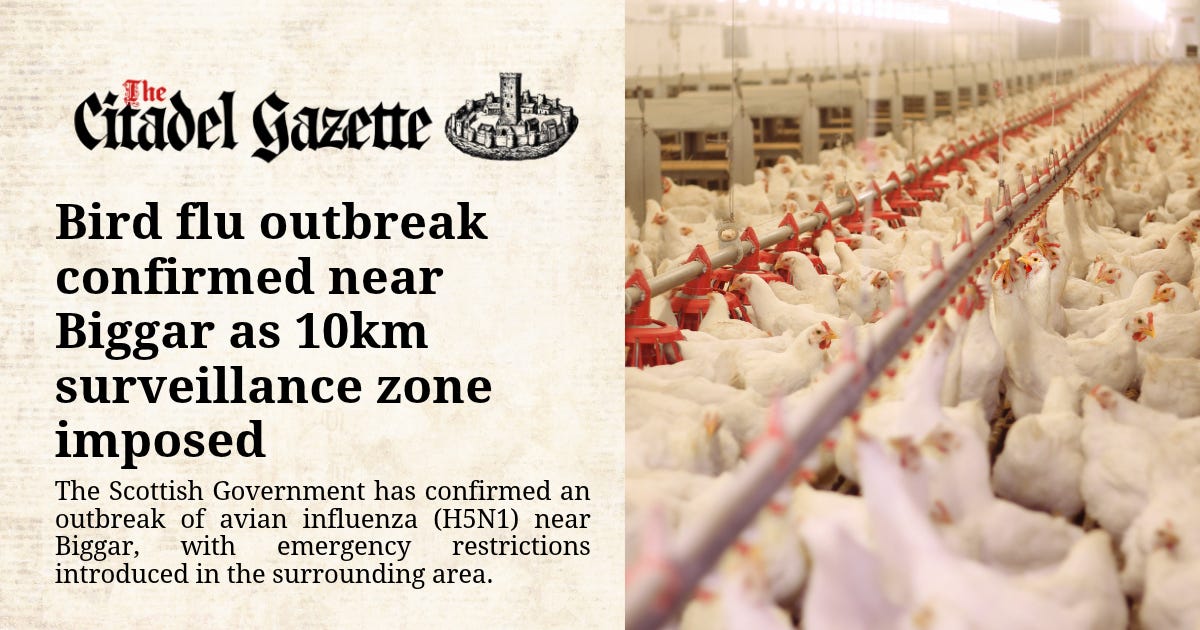
The Scottish Government has confirmed an outbreak of highly pathogenic avian influenza (H5N1) near Biggar, with emergency restrictions introduced for poultry keepers, farmers and other animal owners across the surrounding area.
Authorities confirmed the outbreak at a premises near Biggar, in the Scottish Borders, on Monday 2 November 2026. After confirming the disease a 3km Protection Zone and a wider 10km Surveillance Zone has been established around the affected premises to help prevent the virus from spreading.
The restrictions apply immediately to farms, smallholdings and households in the area that keep chickens, ducks, geese or other captive birds.
Bird keepers within the affected zones must comply with legally enforceable disease-control measures, including increased monitoring, record-keeping and restrictions on the movement of birds and other animals.
What restrictions are in place?
Anyone keeping birds within the designated zones must inspect their flocks for signs of illness and immediately report any suspected infection.
Restrictions are centred roughly halfway between Biggar and Broughton along the B7016, reaching Blyth Bridge and Dolphinton to the North, Quorthquan and Symington to the West, as far as Stobo to the East, and Kingledoors to the South.

Keepers are also required to maintain detailed records of their birds, including flock numbers, illnesses and deaths, feed and water consumption, and egg production. Records must also be kept of visitors to affected premises.
Releasing game birds is not permitted. Movements of poultry, captive birds, eggs, meat and carcases are subject to licensing conditions.
Restrictions also cover the spreading of poultry litter, manure and slurry, as well as certain movements of livestock.
Farmers wishing to move dairy cattle, sheep or goats kept for milk production must obtain a specific licence from the Animal and Plant Health Agency (APHA).
The Scottish Government has warned that the restrictions are legally enforceable and breaches could result in prosecution.
Backyard chicken keepers also affected
The measures do not apply solely to commercial poultry farms.
Residents with a small number of chickens, ducks or geese are required to follow the relevant rules if their property is within the affected area. The Scottish Government has emphasised that an outbreak among backyard poultry can have the same consequences for disease-control measures and the wider poultry industry as an outbreak on a commercial farm.
Bird owners are advised to strengthen biosecurity, prevent contact between captive and wild birds where possible, and remain alert for any signs of illness or deaths.
Another outbreak in Scotland
The Biggar outbreak follows confirmation of highly pathogenic H5N5 avian influenza in Ness, on the Isle of Lewis, on 2 October. According to the Scottish Government’s latest assessment, the risk of highly pathogenic avian influenza H5 infection in wild birds across Great Britain is currently rated as medium.
The risk of infection in poultry and other captive birds is assessed as low where biosecurity measures are inadequate, falling to very low where stringent precautions are maintained.
Scotland’s nationwide Avian Influenza Prevention Zone was lifted in June 2026. Localised restrictions continue to control confirmed outbreaks.
How to check whether your property is affected
The Scottish Government is directing residents and businesses to the APHA’s interactive disease-control map, which identifies the boundaries of the protection and surveillance zones.
Restrictions apply to an entire premises if any part of it falls within a designated zone.
BIRD FLU: SIGNS TO WATCH FOR IN POULTRY
Bird flu (avian influenza) can spread rapidly through chickens, ducks, geese and other captive birds. Key warning signs include:
Sudden death – birds dying unexpectedly, sometimes without showing symptoms.
Swollen heads – particularly around the eyes, neck and throat.
Breathing difficulties – coughing, sneezing, gasping or noisy breathing.
Blue discolouration – particularly of the comb, wattles or legs.
Loss of appetite – reduced feeding, lethargy or unusual behaviour.
Reduced egg production – fewer eggs or eggs with soft or misshapen shells.
Diarrhoea – sometimes accompanied by increased thirst.
Nervous symptoms – trembling, loss of coordination or twisted necks.
IMPORTANT: Not all infected birds show obvious symptoms. Ducks and geese may show fewer signs than chickens.
Suspect bird flu? Do not move birds off the premises. Contact your vet and report suspected cases immediately to the Animal and Plant Health Agency (APHA) on 03000 600 703 (Scotland).
Found a sick or dead wild bird? Do not touch it. Report dead wild birds through the government’s online reporting service.
Bird keepers who suspect avian influenza should immediately contact their vet or the APHA on 03000 600 703.
Anyone seeking clarification about the local restrictions can contact the outbreak information line on 0330 041 6589.
The protection and surveillance zones remain under official review. Residents are advised to monitor government updates for any changes or confirmation that restrictions have been lifted.