

A debate on the future of pubs in Scotland has confirmed an independent review of how hospitality premises are valued for business rates will not report until summer 2027, with its findings to be considered ahead of the 2029 revaluation.
The debate, “Supporting Scotland’s Pubs” held on Tuesday 10 November, followed a motion lodged by Reform UK South Scotland MSP Jamie Langan, who highlighted the closure of the 376-year-old pub as an example of the difficulties facing Scotland’s hospitality industry.
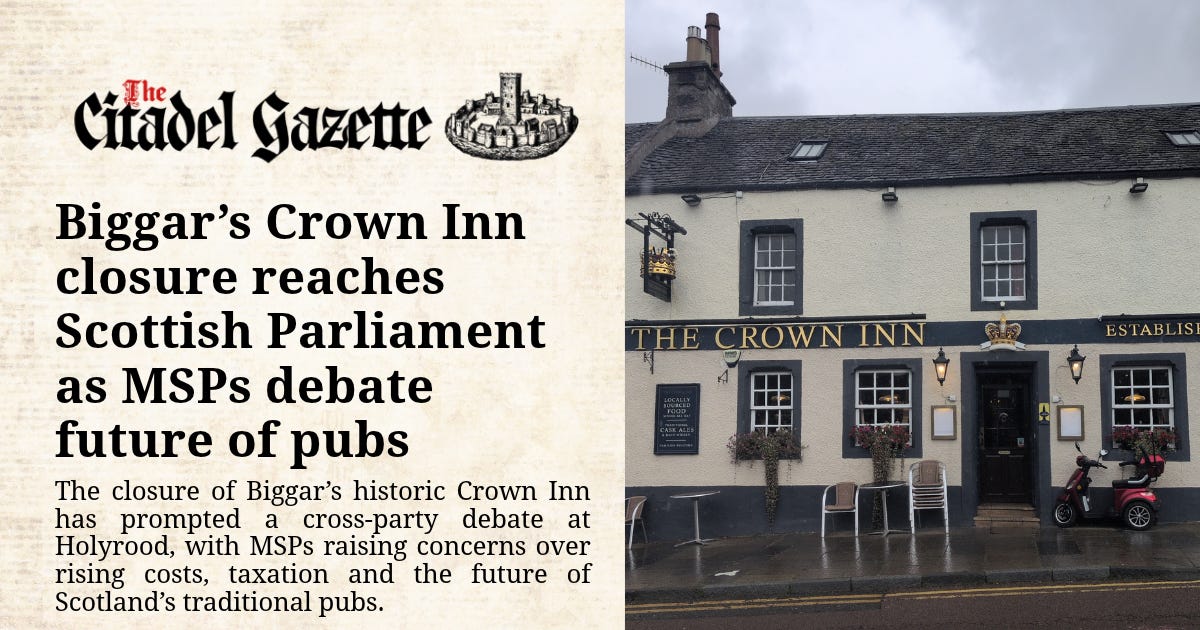
The Crown, a former coaching inn on Biggar High Street which dates back to 1650, closed suddenly on 7 October. It had previously won CAMRA Lanarkshire Pub of the Year in 2016 and the Glasgow and West of Scotland regional award in 2017.
Langan’s motion attracted support from 17 other MSPs, including Conservatives and a Liberal Democrat, while the debate itself drew contributions from SNP and Labour members.
Opening the discussion, Langan recalled visiting the Crown on its final day of trading, saying it was packed with customers saddened by its closure, and noting its historic importance:
“My motion was prompted by the closure of the Crown Inn in Biggar. The Crown Inn first opened its doors in 1650. I ask members to think about that for a moment. It goes back long before the act of union. It survived Jacobite uprisings, economic depressions, two world wars and countless changes of Government. It stood for almost four centuries of Scottish history. And yet, after all that, it could not survive the pressures facing Scotland’s hospitality sector today.”
Jamie Langan MSP
Later in the debate, Labour MSP Joe Fagan also noted the Crown’s historic longevity.
“It is a great shame that the Crown Inn, which has been an institution and a fixture in that community through the decades, has been lost. …I know that it will be missed.”
Joe Fagan MSP
Langan argued that taxation, regulation, energy costs and changing consumer habits were making it increasingly difficult for pubs to survive. He called for business rates reform and stronger planning protections for threatened pubs.
However, the circumstances behind the Crown’s closure are more complicated than rising costs alone. As previously reported by The Citadel Gazette, the Crown’s former operators, Matt and Joanna McKean, had identified an unsuccessful expansion into a second venue as a significant factor in their decision to close.

The couple had expanded their business into Harburn Golf Club in West Lothian in 2025, with plans to operate The Crown @ Harburn. In announcing the closure, they acknowledged that the expansion “didn’t work out the way we wanted it to”, leaving the business in a precarious financial position.
They said that this, combined with increasing costs facing the hospitality industry, meant they could no longer afford to continue trading.
Speaking to The Citadel Gazette following the closure in October, Scottish Hospitality Group director Stephen Montgomery called for a fairer approach to hospitality taxation.
“The cumulative impact of taxation and policy on the sector is simply too much, particularly when combined with rising employment, energy and supply costs and squeezed customer spending.”
Stephen Montgomery, Scottish Hospitality Group
Montgomery also called for lower hospitality VAT from the UK Government and changes to business rates in Scotland.
MSPs raise costs, community value and public health
Conservative MSP Craig Hoy, who chairs Holyrood’s cross-party group on beer and pubs, urged the Scottish Government to pass on any UK-funded business rates relief to Scotland’s hospitality sector in full.
SNP MSP Ben Macpherson raised the possibility of reducing VAT for hospitality, an issue also pursued by fellow SNP MSP Calum Kerr, who said he had written to the Prime Minister calling for the rate to be reduced to 10 per cent.
SNP MSP Emma Roddick highlighted that small bars and pubs were also important as community and entertainment venues.
“I suspected that the importance to communities would be well covered this evening, but as live music and other cultural events face a time of great pressure, it is important that we recognise the support that these smaller venues can provide.
There are traditional musicians in Scotland who became well known thanks to the opportunities that they were given by small venues such as bars. There are people who just go out for a drink and are inspired by music nights to pick up their fiddle again the next day, and perhaps join in next time.”
Emma Roddick MSP
Labour MSP Joe Fagan, who represents South Scotland, acknowledged the loss of the Crown to Biggar and raised concerns about the way licensed hospitality premises are assessed for business rates.
Fagan referred to figures supplied by the Scottish Hospitality Group showing how a hospitality business in Aberdeen faced a higher rates liability than offices occupying a much larger proportion of the same building.
He argued that business rates, VAT and energy costs presented particular challenges for the sector, while warning that any VAT reduction would need to be properly funded to avoid consequences for public finances.
Fagan also highlighted the importance of transport, pointing out that declining bus services and difficulties in the taxi trade could affect both customers and hospitality workers.
There was less agreement over the relationship between supporting pubs and reducing alcohol-related harm.
Labour MSP Carol Mochan recognised the Crown’s contribution to Biggar but challenged the suggestion that public health measures were unnecessarily penalising pubs. She argued that the question was not whether to support pubs or public health, but “how we support both”.
SNP MSP Jenni Minto also drew attention to the Oakbank Community Inn in Sandbank, Argyll, which had been acquired through a community-led initiative supported by local shareholders and the Scottish Land Fund.
Government confirms business rates review delay
Responding to the debate, Scottish Government Minister for Business and Fair Work Tom Arthur acknowledged the impact of the Crown’s closure on its operators, staff and the wider community.
“When any business that provides an important service to communities closes, it is always regrettable, but when it is a business such as the Crown Inn, with its heritage, landmark premises and community hub status, it is more than just another business gone from our high streets—the impact has a broad reach.”
Tom Arthur, MSP, Minister for Business and Fair Work.
Arthur recognised that the hospitality industry was experiencing prolonged economic difficulties, including inflation, rising staff and supply costs, and pressure on consumer spending.
He defended existing Scottish Government support through non-domestic rates relief, including the Small Business Bonus Scheme and assistance for eligible retail, hospitality and leisure businesses.
However, he also acknowledged concerns about the way hospitality premises are valued.
An independent review of the valuation methodology for licensed hospitality businesses, originally expected to report by the end of 2026, has now been delayed to summer 2027 following a change of chair.
The review, now chaired by advocate Jonathan Murphy, will consider whether the existing system fairly assesses the rateable value of pubs, hotels and other licensed premises.
Its findings and recommendations will be considered ahead of the next business rates revaluation in 2029.
Importantly, the review focuses on how properties are valued, rather than the level of taxation applied or the relief schemes available to businesses.
Could the Crown reopen?
Despite its closure, there is still hope the Crown will reopen. Belhaven Pub Partners, part of Greene King, has confirmed that it is actively seeking a new operator for the premises.
A spokesperson told The Citadel Gazette:
“We’re sad to see our long-standing partners at The Crown make the difficult decision to leave the pub and wish them all the very best for the future. We’re now looking for the right partner to continue to run The Crown, with the backing and support of our award-winning team.
We’d encourage anyone with experience of running their own pub or hospitality business to get in touch.”
The company’s current advertisement offers the Crown under a three-year Scottish tenancy agreement, with an annual rent of £75,000 and estimated entry costs of £46,250.
Belhaven forecasts annual operator turnover of approximately £978,000 and operator profit of around £75,000. These are prospective trading estimates provided by the company, rather than verified figures from the previous operators’ business.
The advertisement describes the Crown as a destination dining pub, with approximately 100 dining places across three areas, a traditional bar and private accommodation.
Finding a new operator willing to take on the business under those terms will be central to the Crown’s future.
The wider impact of the Crown’s closure was also reflected in comments on social media “One much-valued business closing in small towns like ours has a huge ripple effect on many others,” said resident Yvonne Moorhouse “This pattern is increasingly common across Scotland and has implications for problems across the country of rural depopulation because of reduced jobs and services.”
Other locals noted that visitors are still coming to Biggar looking for the Crown. Nyisha May Rodney said, “In the first few days post-closure, I updated 5 parties who had driven INTO Biggar to dine there and were gutted it’d closed down. It’s greatly missed. I hope its doors can open again.”
Echoing concerns about other recent Biggar high street closures, Roma French said, “Great pub. First the bank goes then the pub. We need everyone to support local businesses to keep Biggar as a lovely and unique town.”
The Holyrood debate has given Biggar’s loss national attention and highlighted the wider pressures facing Scotland’s pubs. The members’ business debate concluded without a vote, which is normal for this type of debate, and no specific measures to assist the Crown’s reopening were announced. It has also shown broad cross-party agreement on pubs’ value to communities, even as politicians differ over the causes of closures and the solutions.
While longer-term reform of business rates remains under consideration at Holyrood, and the hospitality industry continues to press Westminster for lower VAT, the Crown's immediate future depends on finding an operator who can make the business commercially sustainable.
For Biggar, the question now is whether a new operator can be found to bring the Crown back to life.